
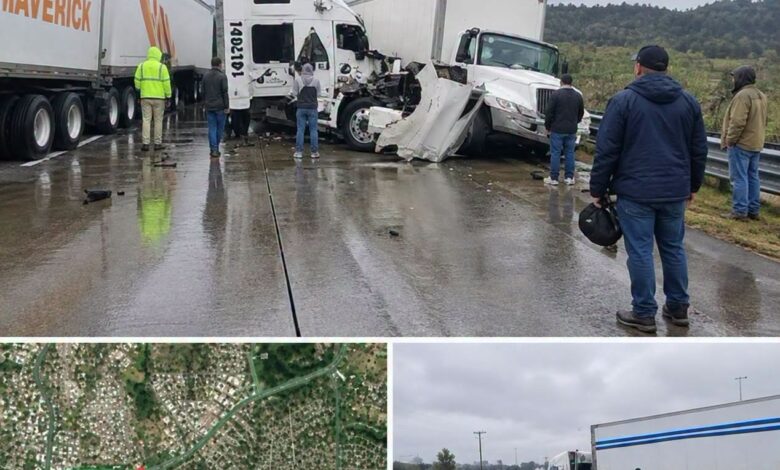
Metal screamed, brakes failed, and in seconds one of Mexico’s busiest highways became a scene of chaos. Cars crushed, traffic paralyzed, sirens echoing over Huehuetoca. Was it speed, fatigue, or a deadly mechanical failure? Witnesses speak of rain, panic, and a trailer that never slowed down. Authorities now dig for answ…
On a day like any other, the Mexico–Querétaro Highway suddenly turned into a corridor of fear. Drivers who moments earlier were commuting or hauling cargo found themselves trapped behind a trailer sprawled sideways across all three lanes, its weight and momentum having overpowered any chance of control. Crumpled vehicles, shattered glass, and stunned survivors marked the violent path of the impact, while the line of stranded cars stretched for kilometers under a tense, uncertain sky.
Behind the twisted metal lies a familiar, uncomfortable truth: disasters like this rarely have a single cause. Speed, possible brake failure, fatigue, light rain, and dense traffic may have converged in a few unforgiving seconds. Yet amid the wreckage, there was also discipline and solidarity—first responders working relentlessly, drivers helping one another, and a shaken community demanding safer roads, stricter controls, and the hope that this terrifying afternoon will not be repeated.
For those caught in the disruption, the highway was no longer simply a route between places. It had become a scene where movement stopped and the ordinary confidence of a journey gave way to fear. The damaged vehicles, the blocked traffic, and the sound of sirens were immediate facts of the scene described in the account. They were also the details that made the incident difficult for witnesses to forget.
The questions about speed, fatigue, and mechanical failure remain questions in the story. Each points toward a possible part of the explanation, but none can be selected as the answer merely because it sounds plausible. The accounts of rain and panic provide a picture of the experience on the road. They do not, on their own, establish the sequence of events that investigators would need to reconstruct.
That distinction matters for the people affected by the crash. A clear explanation should connect what happened before the collision with what happened during it, rather than turn uncertainty into blame. The report describes authorities seeking answers, leaving the cause unresolved while the consequences were already visible.
The interruption also extended beyond the point of impact. Drivers approaching the area encountered stopped traffic and a road that could no longer serve its ordinary purpose. Some were close enough to see the aftermath, while others experienced the incident through delay and uncertainty. The same stretch of highway held several different perspectives on one sudden event.
What remains central is the human cost behind the report. The dramatic scene was not only a traffic problem; it was an event that affected lives and left people waiting for explanations. Remembering that cost keeps the focus on those involved, while the questions about how the collision began remain with the investigation. A complete account would need those questions answered carefully, with evidence rather than the assumptions that can form in the first moments of shock.